



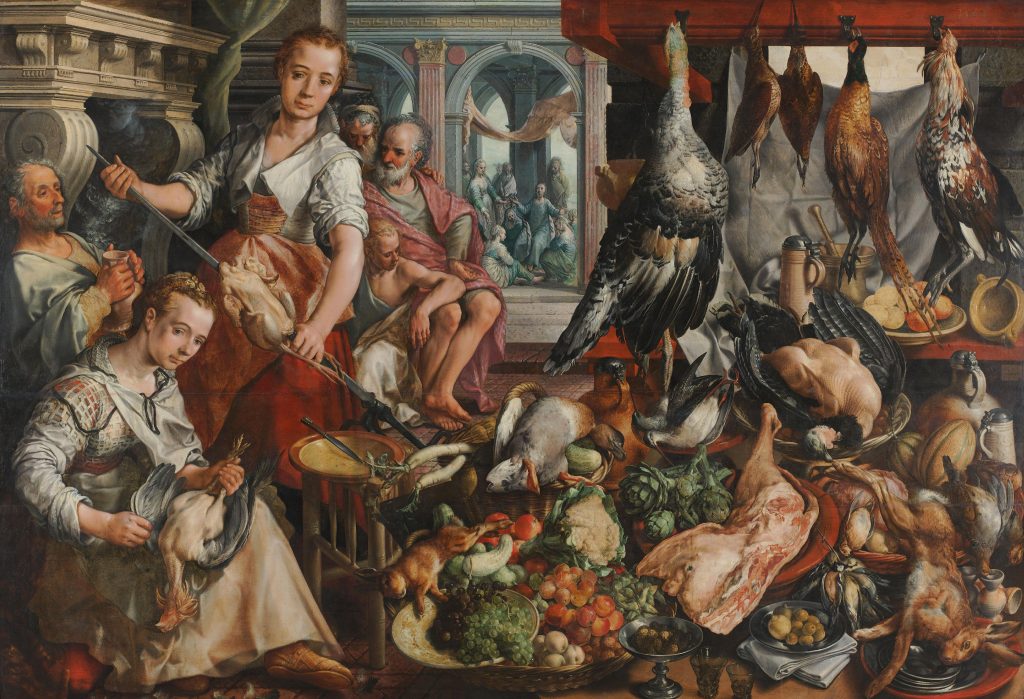
The Well-Stocked Kitchen (1566), Joachim Beuckelaer (c. 1534–1576).
What would you like for dinner tonight? In this vivid scene by the Flemish painter Joachim Beuckelaer, there are plenty of options. Fowls in various stages of defeathering, listless rabbits, and succulent slabs of meat await the hands of a pair of kitchen maids busily skewering and plucking the corpses under their care. Vegetarians may even be catered for, given the range of verdant vegetables and rich, juicy fruits. Fine, choice wines seem to be on offer, as a contented-looking man by the fire seems to be ensuring that the vintage is still good. Amid the bustle of the well-stocked kitchen, several other figures are enjoying the commotion, perhaps hoping to serve as impromptu taste testers for the feast.
In the background of this rather active still-life, another scene unfolds. Framed within a classical arch and partially covered with a flowing canopy, a man with outstretched arms speaks to a group of women who listen attentively at his feet. Another woman has come upon the group, and seems to make a modest protest. Several men observe the scene with interest. In contrast to the vivid colors of the foreground fowl and fauna, these figures are painted in muted tones, their blue and green cloaks contrasting with the vivid reds that frame the kitchen scene.
In these juxtaposed scenes, Beuckelaer draws on an artistic tradition of monumental genre scenes developed by his teacher Pieter Aertsen (c. 1507–1575). In a 1552 painting now in Vienna, Aertsen contrasts a foreground still-life of a table full of luscious food with a depiction of Jesus talking with two women. An inscription on the mantlepiece makes the occasion clear: Mary has chosen the better part (Lk 10:42). Aertsen juxtaposes the kitchen of earthly delights with the biblical story of Mary and Martha recounted in Luke 10:38-42 and proclaimed in the liturgy on the feast of Saints Martha, Mary, and Lazarus (July 29):
Jesus entered a village where a woman whose name was Martha welcomed him. She had a sister named Mary who sat beside the Lord at his feet listening to him speak. Martha, burdened with much serving, came to him and said, “Lord, do you not care that my sister has left me by myself to do the serving? Tell her to help me.” The Lord said to her in reply, “Martha, Martha, you are anxious and worried about many things. There is need of only one thing. Mary has chosen the better part and it will not be taken from her.”
Following in the brush strokes of his master, Beuckelaer’s Well-Stocked Kitchen juxtaposes the outward goods of earthly food and drink and the inward mystery of Christ’s comforting and challenging words. In Beuckelaer’s depiction, the outstretched arms of Christ seem to distinguish between the outward cares of Martha and the inward concern of Mary while encircling both women in his magnanimous embrace.
In the view of some art historians, Aertsen’s and Beuckelaer’s paintings are meant to contrast the self-love of those who follow worldly desires and the divine love of those who strive for the Kingdom of Heaven. While there is certainly truth to this perspective, there is also an element of synthesis between the outward and the inward in these paintings. Christ has truly come into this world to live among us. From the wedding feast at Cana onwards, Jesus truly dwelt among his people, dining and drinking with them. Jesus does not come to destroy our human nature, but to restore and elevate it.
Jesus does not deny the need for outward things—in his Incarnation, the invisible Son of the Father has truly taken on a human body, like us in all things but sin, that needs to be nourished—but he insists on the right ordering of the external and the internal. He has taken on our flesh not only to dwell among us, but to give us the chance of dwelling with him. Through his visible form, he lifts us up to the love of things invisible: “For in the mystery of the Word made flesh a new light of your glory has shone upon the eyes of our mind, so that, as we recognize in him God made visible, we may be caught up through him in love of things invisible” (Preface I of the Nativity of the Lord).
Jesus knows that we need to eat and drink, but invites us to rightly order these earthly needs: Do not worry and say, “What are we to eat?” or “What are we to drink?” or “What are we to wear?” All these things the pagans seek. Your heavenly Father knows that you need them all. But seek first the kingdom [of God] and his righteousness, and all these things will be given you besides (Mt 6:31-33).
Even in the liturgy, we need to seek a right ordering of the external and the internal. As Cardinal Ratzinger once preached, “In the Liturgy we should also give the service of Martha: offering a sacred space to the Lord, offering him our preparations, well-planned ceremonies, and the chant, offering him the gifts of the earth, the bread and the wine. All of this is very necessary, and it is equally necessary to do it well. Yet nonetheless, if the ‘Marian’ dimension is not also present in the liturgy—the contemplative dimension in which we simply sit at the Lord’s feet—the most essential thing has gone missing.”
In the sacred banquet of the Eucharist, Jesus unites the outward nourishing of bodily food with the inward nourishing of the soul. He offers not merely the bounties of a well-stocked kitchen, but something far more satisfying: Whoever eats my flesh and drinks my blood has eternal life, and I will raise him on the last day (Jn 6:54). The same Jesus who visited the home of Martha and Mary wants to enter our homes as well: Behold, I stand at the door and knock. If anyone hears my voice and opens the door, [then] I will enter his house and dine with him, and he with me (Rv 3:20).
Father Innocent Smith, O.P.
Dominican friar of the Province of Saint Joseph and professor at the University of Notre Dame. He is the author of Bible Missals and the Medieval Dominican Liturgy.

Additional art commentaries