



Holy Week sorrow and hope
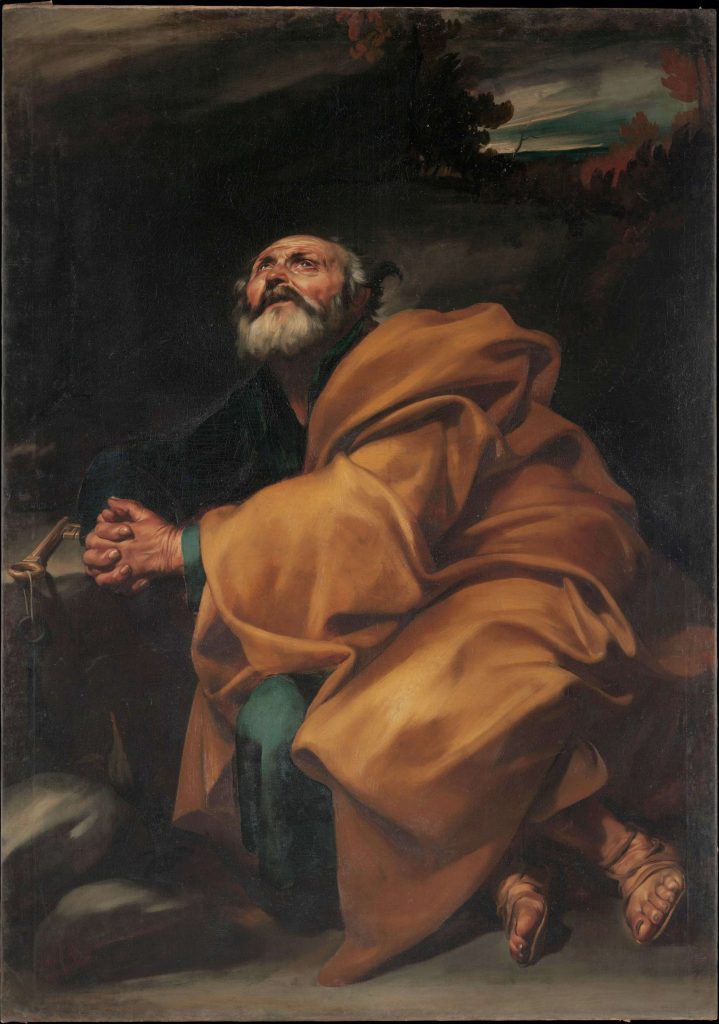
This marvelous work by the young Spanish artist Jusepe de Ribera provides for rich meditation on Saint Peter and the mercy of God. In this one captured moment, in symbols and style, a full story emerges. Of course we already know the story, and we hear it again in Holy Week at the Palm Sunday and Good Friday liturgies. Here in visual form, the account of Peter’s triple denial of Jesus and subsequent repentance unfolds silently with the compelling force of beauty.
Pivotal moment
Light from above illuminates the single figure of Saint Peter, who is set in a dark, rocky outdoor place. His upturned face shows his red, teary eyes. The intent look reveals his anguished heart: he has recalled his broken promise to Jesus, Though all may have their faith in you shaken, mine will never be (Mt 26:33). The distant sky shows the first traces of dawn with streaks of light breaking the night; the cock has crowed and Jesus’ words have come true: Amen, I say to you, this very night before the cock crows, you will deny me three times (Mt 26:34). Yet, despite the betrayal, it is not a scene of despair. It is, rather, one of remorse. We can observe the apostle’s focused eyes and the furrowed brow; his face is the brightest part of the painting, in front of the darkest. He has wept bitterly (Mt 26:75) and is full of contrition.
In a penitential posture, almost crouching or cowering, not quite kneeling and not quite sitting, he cranes his neck to look high above, where a bright light is shining. Something, or Someone, has caught his attention and caused him to lift his head from a place of sorrow. His mouth is slightly open—is he catching his breath, having found not condemnation but mercy?
Rising, not falling
With his sandaled feet awkwardly turned sideways, he is in no position to move quickly. Yet he is not quite sinking into the darkness behind. His right arm, barely visible in front of the obscure, formless background, still supports his torso. The golden-ochre robe, in contrast to the dark tunic underneath, almost shimmers with highlights. Its deep, voluminous folds, masterly rendered with the chiaroscuro technique, make it appear weightless, or caught by a great wind. We are sure he is rising, not falling. Soon these feet, just washed by Jesus, will be running to see the empty tomb (Jn 20:4).
Even the keys placed beside Saint Peter’s clasped hands, keys to the kingdom of heaven (Mt 16:19), seem to share in the drama: will they be left aside, allowed to drop to the ground? No, they will not. The solid rock on which they rest is a reminder of Jesus’ declaration and promise: You are Peter, and upon this rock I will build my church, and the gates of the netherworld shall not prevail against it (Mt 16:18). After the Resurrection, the hands which accepted the keys will also accept chains of imprisonment for the sake of Christ (Acts 12:6).
Not on a pedestal
Ribera has brought us a close-up view of Simon Peter. We are just in front of him, the one whom Christ entrusted with the authority of the Church. He is not above us on a pedestal. Nor is he seated in a position of teaching authority or reigning as Prince of the Apostles in the heavenly realm. He is simply pleading for and receiving the mercy of God, which is expressed by the light from above and the overall mood of the work. Our proximity is an invitation to imitate him.
Before his denials, Peter had reiterated his pledge: “Even though I should have to die with you, I will not deny you.” And all the disciples spoke likewise (Mt 26:35). We can surely count ourselves in that number, among all the disciples who then, within hours, on the Mount of Olives, forsook [Jesus] and fled (Mt 26:56). We all share in the experience of breaking our promises to God. We all are in need of his mercy.
That reality makes this scene so poignant, and the eminence of Saint Peter so relevant. Even he, who had followed Jesus so closely, had heard God’s voice and seen God’s majesty with his own eyes (2 Pt 1:16-18), is human and frail. It is not by making more promises or exerting stronger effort that he repents; rather, he is suffering the pain which accompanies the acknowledgement of his betrayal and allowing God to change him. In this way, Saint Peter is an exemplar of hope which does not despair, does not presume, and requires humility. This is the difference between him and Judas Iscariot, who also betrayed Jesus, likewise regretted it, but despaired and hanged himself (Mt 27:3-5). Ribera’s work brings us closer to the real Simon Peter, with his human weakness, mistakes, and need for God. In imitating him, we do not need to try to climb a pedestal. We need only lift our heads to find God’s mercy already flooding us with light.
Jennifer Healy
Taught art history for many years and now works for the USCCB in the office
to Aid the Church in Central and Eastern Europe.

Additional art commentaries