



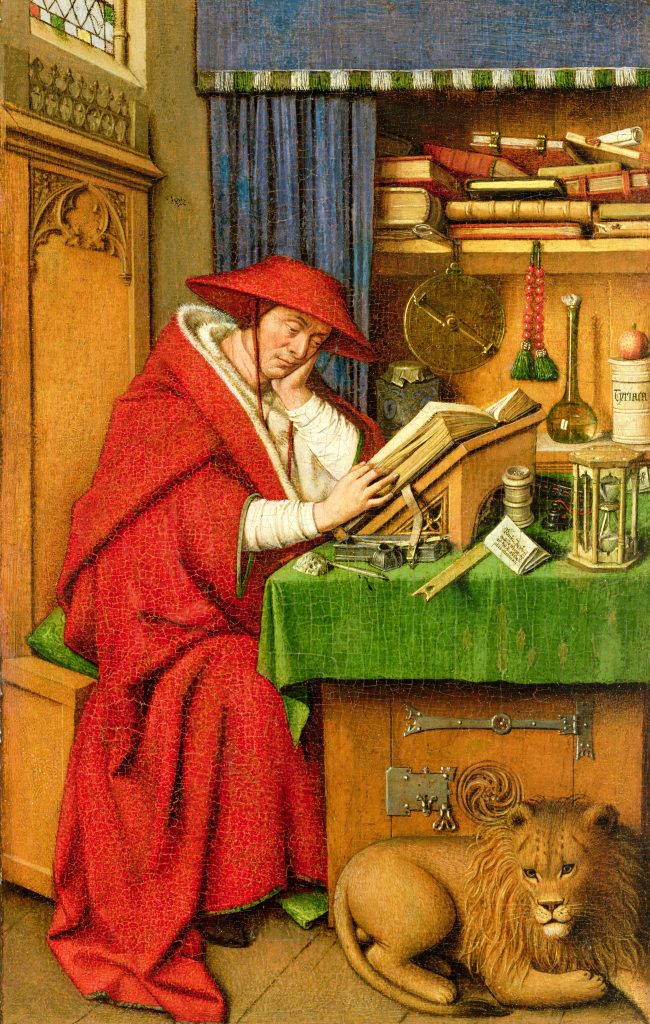
Saint Jerome in His Study (c. 1435), Jan van Eyck (c. 1390–1441).
For centuries the Church has remained indebted to Saint Jerome, the 4th-century scholar and Doctor of the Church whose translation work made it possible for “the treasures of the Bible to be opened more lavishly, so that richer fare may be provided for the faithful at the table of God’s Word” (Sacrosanctum Concilium, 51). In his early-15th-century masterpiece Saint Jerome in His Study, the gifted Flemish painter Jan van Eyck offers a striking visual homily. A prominent figure in the Early Netherlandish painting school, van Eyck uses vibrant color, warm light, and rich symbolic details to evoke the power of God’s Word in the life and work of Saint Jerome.
From a young age, Jerome (c. 347–420) was immersed in the study of literature and languages. Not long after his baptism in 366, he placed his significant linguistic and literary talents at the service of the Word of God. He lived an ascetic life of study and prayer in a continuous lectio divina, reading and contemplating God’s Word. The fruit of his long years of study was the collection of original and revised Latin translations known as the Vulgate, which became the official Latin text of Scripture.
Feasting at the table of God’s word
Jan van Eyck places Saint Jerome in the corner of a warm interior space where he is seated at an ornate desk covered with a deep green tablecloth. The delicately carved high-back seat suggests a cathedra, a bishop’s liturgical chair. Jerome is clothed in a vibrant red robe and a red hat or galero, a medieval headdress worn by cardinals. The saintly scholar’s head is inclined in deep contemplation of God’s Word.
With his right hand, Jerome gently touches the pages of Scripture. One can feel the movement of the sacred text as the living Word of God. In a blue curtained niche behind him are recessed shelves with large and small reference books and an astrolabe, an astronomical instrument used to chart the stars. Green and red bead tassels indicating his cardinal rank hang nearby. And on top of a white jar labeled “TYRIRICA,” thought to be an antidote to physical or spiritual poisons, is a pomegranate, a symbol of Christ’s Resurrection. The dark glass bottle near the sacred text reflects light streaming in from the high upper left window. This subtle glimmer of reflected light evokes the light of the Holy Spirit who inspires Jerome’s study and contemplation of God’s Word.
A large hourglass on the table in front of Saint Jerome suggests the gradual passage of time and human mortality. On the folded letter, in plain sight, is a clear salutation, addressed to an unnamed cardinal. Historians suggest it refers to Cardinal Niccolò Albergati, patron and friend of van Eyck, who may have commissioned and owned this exquisite painting. In the lower right corner, a crouched lion alludes to the legend that Saint Jerome extracted a thorn from the paw of the animal, who became his lifelong companion.
Jesus, the living and incarnate Word
“Ignorance of the Scriptures is ignorance of Christ.” These words attributed to Saint Jerome direct our gaze to Jesus Christ, who stands at the heart of Sacred Scripture. And what may we learn from Saint Jerome today? “This above all: to love the Word of God in Sacred Scripture…. It is important that every Christian live in contact and in personal dialogue with the Word of God…. On the one hand, it must be a truly personal dialogue because God speaks with each one of us through Sacred Scripture and it has a message for each one of us. We must not read Sacred Scripture as a word of the past, but as the Word of God that is also addressed to us” (Pope Benedict XVI).
Moreover, Pope Benedict continues, “although it is a personal Word, it is also a Word that builds community, builds the Church. We must therefore read it in communion with the living Church.” Saint Jerome reminds us that “human opinions come and go. What is very modern today will be very antiquated tomorrow. On the other hand, the Word of God is the Word of eternal life, it bears within it eternity and is valid for ever. By carrying the Word of God within us, we therefore carry within us eternity, eternal life.”
Jem Sullivan, Ph.D.
Associate professor in the School of Theology and Religious Studies at The Catholic University of America and the author of Way of Beauty: Rekindling Eucharistic Amazement with Visio Divina (Our Sunday Visitor).

Additional art commentaries