



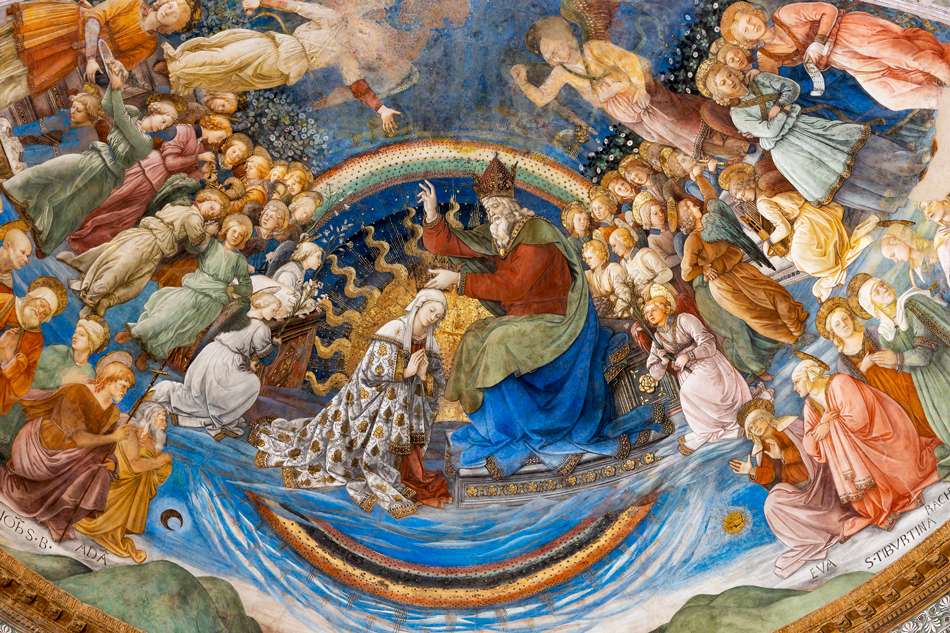
Coronation of the Virgin (1469), Fra Filippo Lippi (1406 –1469).
Perched high in the Umbrian hills, far from the bustle of Florence and Rome, Spoleto rewards those who seek its seclusion. Quiet streets converge on the city’s cathedral, which houses an exquisite yet obscure masterpiece: Fra Filippo Lippi’s Coronation of the Virgin. Arches recede into the cathedral’s vast nave, guiding the viewer’s eye to contemplate this otherworldly vision in the semidome of the apse. Here, framing architecture appears to open into the empyrean, where Mary is crowned. Such illusionistic rendering suggests the dome of the heavens hovering over the altar—the sacred place where heaven and earth meet.
Queen of Heaven
The Virgin kneels, her body angled slightly toward the viewer, with inclined head and lowered eyes. Her fingertips delicately meet; the open space between her hands creates a sense of depth also felt in the drapery that defines her form. In posture and solemn aspect, she perfectly mirrors Lippi’s most celebrated portrayal of the Virgin: his Mystical Nativity (1459). In that piece, however, robes embroidered with pearls set in gold (Ps 45) are replaced with a simple mantle; the clouds of heaven become the soil of earth. Mary kneels not to receive a crown, but—in poverty and obscurity—to adore her infant Son. This contrast underscores the significance of the Coronation. Truly, God has lifted up the lowly (Lk 1:52). God’s descent to her becomes her ascent to him, as she who offered him a home on earth is now sheltered by the highest heaven. Fittingly, the Coronation fresco was unveiled on Christmas day. Lippi, having died upon its completion, is buried beneath.
Angels escort a throne intended for the Virgin, eager to usher in her reign. Two hover above the central scene, recalling the pair of golden cherubim that once spread protective wings over the ark of the covenant. Mary—the new ark, the dwelling place of God among men (cf. Rv 21:3)—is now in their midst. The celestial courtiers attend the Domina Angelorum with great jubilation. Flute, bagpipe, cymbal, and organ accompany their melodious praise. This musical harmony reflects the harmony of heaven and earth: “Through [Mary], our age-old war against our Creator has come to an end. Through her, our reconciliation has been forged…human beings join with the chorus of angels” (Saint John Damascene). Indeed, the Church echoes the angelic choir throughout the liturgical year. Four Marian hymns mark the seasons: three acclaim Mary as Queen—the Salve Regina, Ave Regina Caelorum, and Regina Caeli—while the Alma Redemptoris Mater, reserved for Advent and Christmas, extols her divine motherhood.
Both sun and moon glow beneath the threshold of heaven—the moon below Mary, the sun below God. These details suggest Mary’s total dependence upon him: the moon has no light of its own; it merely reflects the light of the sun.
Revelation
This vision of eternity remains iconographically linked to episodes in time. Directly below, scenes of the Dormition and Assumption identify the Coronation as the final event in the pictured life of the Virgin—the culmination of Mary’s transitus from this world to the next. Craggy cliffs surrounding her funeral bier become verdant everlasting hills (Gn 49:26); a muted palette below cedes to the chromatic vibrancy of paradise. Assumed body and soul into heaven, Mary commences her celestial reign.
Without obscuring this evident meaning, key details point toward something more. The fresco is replete with apocalyptic imagery: its central figures are distinguished by a circular clipeus—a reference to the rainbow encircling God’s throne in the Book of Revelation (4:2-3). Mary is portrayed as the mulier amicta sole, the Woman of the apocalypse clothed with the sun, with the moon under her feet (Rv 12:1). God the Father, crowned with the papal triregnum, extends his hand in benediction. This gesture recalls the triumph of the elect at the end of time: Come, you who are blessed by my Father. Inherit the kingdom prepared for you from the foundation of the world (Mt 25:34).
These details allude to a great mystery (Eph 5:32), which shines through like a palimpsest beneath the Coronation of the Virgin. “Crowned in glory,” says Pope John Paul II, Mary is “the anticipation and the supreme realization of the eschatological state of the Church.” Christian tradition has long conceived of Mary as the Woman par excellence—a figure of the Church. Lippi’s fresco thus presents an apocalyptic vision. The great tribulation and final judgment have passed, and the glorified Church is presented before the Father’s throne without spot or blemish, lavishly arrayed as a bride.
Church
Lippi’s Coronation, functioning as an allegory of the Church in splendor, portrays the consummation of salvation history. The presence of Adam and Eve, who look on from below, calls to mind its fateful outset. Yet God did not institute the Church merely in response to sin; her origins reach into eternity.
Michelangelo’s Creation of Adam and Lippi’s Coronation depict “bookends” of salvation history. In the beginning, the Father creates; at the eschaton, the Father elevates and crowns his creation. Michelangelo pictures the Father ensconced within a swathe of fabric resembling the cross-section of a brain. As he reaches toward Adam, his other arm cradles Woman—with all the symbolic import she carries. She is Eve, the prefiguration of Mary, who in turn personifies the Church. “In the back of God’s mind” from the very beginning—the final work before his sabbath rest—she is last in creation, first in God’s plan.
“The world was created for the sake of the Church…for the sake of communion with [the] divine life” (CCC, 760). The fullness of this communion is achieved at the eschaton. Lippi’s Coronation, therefore, depicts the apotheosis of redeemed humanity, raised up from the dust of the earth to the bosom of the Trinity. This is God’s Church in whom he delights, his masterpiece realized at great cost. She is invited by him into beatitude past utterance, to be sheltered eternally within his very heart.
Amy Giuliano
Holds degrees in theology from the Angelicum in Rome and art history from Yale.

Additional art commentaries