



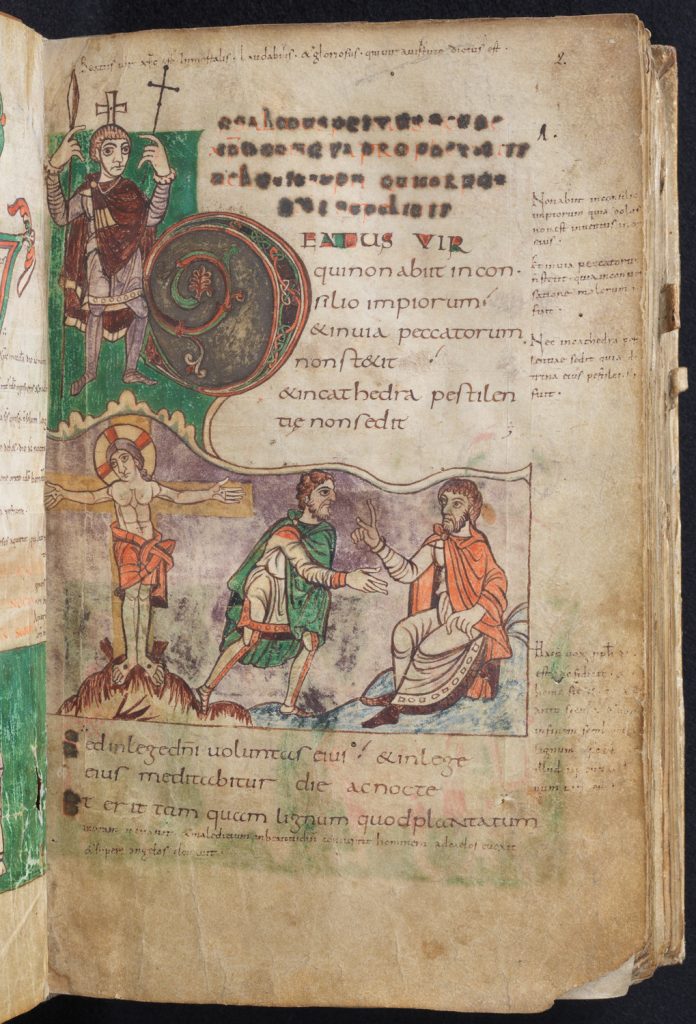
Blessed the Man (Ps 1), Stuttgart Psalter
Pilate’s words, Behold, the man! (Jn 19:5) are cruel mockery as he displays the whipped and bloodied prisoner to the screaming crowd. The words mean: look at what you call a man. Look at how weak he is. How defenseless. How beaten down. And the words have menace: this is who you are in the hands of Roman justice, and any one of you could be next.
But the unknown artist of the early-9th-century Stuttgart Psalter noticed that, through the mockery and the menace of Pilate’s words, an echo of another voice can be heard: Blessed the man (Ps 1:1). The man to whom the Psalter first directs our gaze is also the man on Pilate’s balcony and the man on the cross. To gaze on that man, the artist proposes, is to discover the One who reveals the true nature of every man and every woman.
A model of blessing
In the hands of the Stuttgart illuminator, the first letter of the first word of the Psalter expresses a whole theological universe in miniature. The “b” in “blessed” (beatus) is composed of the upright form of King David and a growing, curling vine. At one level, then, David himself is the “blessed man” Psalm 1 calls us to behold, whose vibrant life with God causes new growth to spring up like verdure covering once-barren earth. Since the whole Psalter was traditionally thought to have been composed by David, every word in the book is both an effect of David’s blessing and a means by which the one who prays the psalms enters into David’s gifts.
But how exactly is David blessed? The artist suggests an answer by depicting David as a powerful, youthful warrior, clad in armor and a royal cloak, who wields a spear in his right hand and a cruciform scepter in his left. The portrayal evokes David’s first victory over Goliath as a boy, as well as the series of victorious conquests that marked David’s whole life, first as military commander for Saul and then as king himself. But battles, victory, and power are not the point of the story. The blood on David’s hands prevents him from building the temple; God’s dwelling place on earth will only be built by the man of peace (1 Chr 22:8-9). Over the head of David the Warrior rises a new sign: the sign of the cross.
New David, new blessing
Directly below the martial figure, the New David appears: the beardless, youthful Christ, stripped of all royal trappings, hands bearing nothing but the nails that pierce them. Jesus, son of David, reveals the true nature of kingship and victory. The perfect king of Israel, the eternal King of heaven and earth, does not conquer with the sword or terrify people into subjection. He reigns from a tree, crowned with thorns and clothed only in derision. His radical humility upends the cynical conviction that might makes right. Love, not power, is the true force that governs reality.
Because Jesus is the New David and the heir to God’s promises to David’s line, all David’s blessings are transformed and expanded in Jesus Christ. Read in the light of the cross, the whole Psalter becomes a revelation of Christ’s face, the perfectly “blessed man” who moves the human heart to seek him. The artist of the Stuttgart Psalter places Jesus Christ on the opening page of his work because he is convinced that the book of Psalms is really about Jesus Christ, and that by praying with it, we share ever more deeply in the blessings he poured out on the cross.
Of David’s line
But how exactly do the blessings promised to David and fulfilled in the New David come down to us, who are neither of David’s line nor contemporaries of Jesus’ earthly life? The remaining two figures in the scene point the way. A figure clad in a green cloak walks off Mount Cavalry and towards another mountain, where an orange-robed figure sits teaching. These figures express the only way the Church grows and moves through time: not by the sword, nor even by the ties of family, but by teaching and receiving the sacred mysteries that come from the cross. The graces that Christ pours out from his pierced side come to you and me from priests who enact Christ’s words in the sacraments, and from the countless men and women who teach us by word and deed who Jesus Christ is. This mystery is the Church, which the artist visualizes as a river of grace that receives the promises made to David and the people of Israel, bursts into waves of glory on the cross, and flows out into human history.
Blessed are the merciful
Taken together, the figures on the first page of the Stuttgart Psalter give insights into why Easter Sunday and Divine Mercy Sunday bookend a single eight-day celebration—the Easter Octave. We cannot bootstrap ourselves to the graces of the cross. We cannot teach ourselves the saving truths of the Incarnation. We cannot impress God with our great deeds. To enter into the resurrected life of the Blessed Man, Jesus Christ, we need to be washed in his blood, receive forgiveness, and learn the Truth who overcomes the lies we tell ourselves. In other words, we need mercy—which is the life of the Church. Blessed the man whom we behold scourged and bloody. Blessed the man who offered his life to give us mercy. Blessed are we when we long to see his face.
Father Gabriel Torretta, O.P.
Scholar of medieval Christianity who teaches theology at Providence College in Rhode Island.

Additional art commentaries