



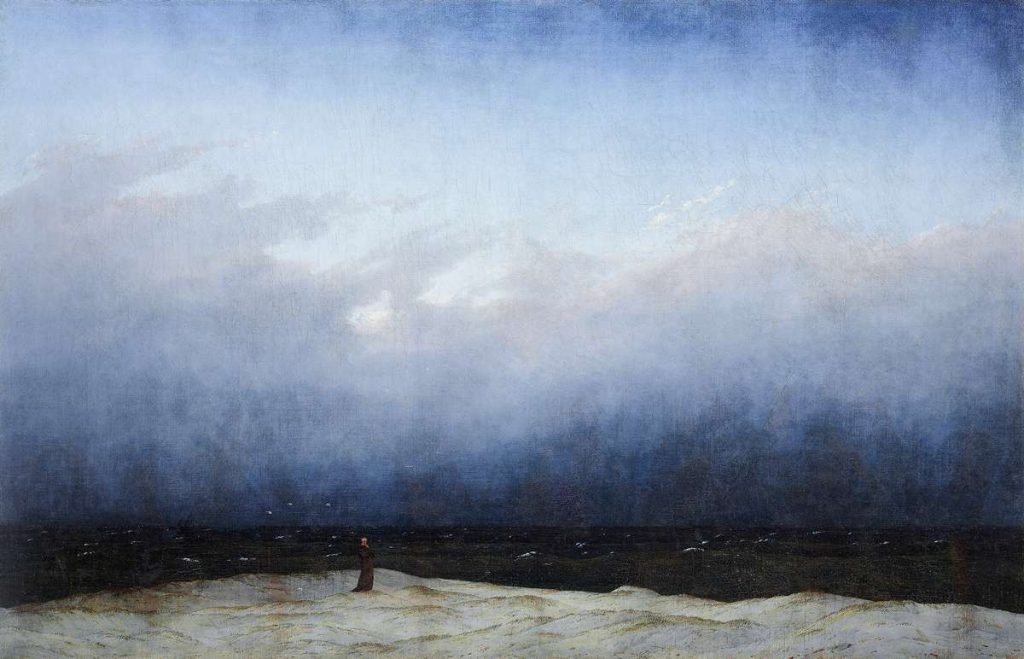
The Monk by the Sea (1808–1810), Caspar David Friedrich (1774–1840).
From the relative safety of shore, a solitary figure surveys white-capped waters, brooding clouds, and a boundless sky. The horizon stretches unbroken before him; the heavens dominate his diminutive form. Though his religious garb suggests faith, his head and heart are level with the restless waves. He is a question—an image of existential longing. He is Caspar David Friedrich’s Monk by the Sea.
Viewing Friedrich’s art is like “eavesdropping on someone’s prayers” (Helmut Börsch-Supan). The artist’s devout Lutheran faith and ascetic lifestyle informed his landscapes—often populated by lone, faceless figures—with a reverential mood. Friedrich stood at the vanguard of German Romanticism, and his oeuvre echoes the movement’s firm conviction: “Nature is the living, visible garment of God” (Goethe, 1808). When criticized for eschewing traditional religious iconography in favor of landscape, the artist asserted the religious possibilities of the genre and his distinctively Christian approach.
From a tender age, Friedrich was captivated by the natural beauty of Rügen, an island near his hometown of Greifswald on the Baltic Sea. It was here that he first heard the shore sermons of Lutheran pastor Ludwig Gotthard Kosegarten, whose plein-air preaching to seasonal fishermen was accompanied by the “trumpets of the sea and the many-voiced pipe organ of the storm” (Kosegarten, Jucunde, 1803). The island’s austere coast—with its icy waters, bracing winds, and barren dunes—is the setting for Monk by the Sea.
Genesis
No topographical markers betray this location. Friedrich empties the canvas, distilling “into the most elemental pictorial language an experience of the natural world that…approaches the universal and the timeless” (Hokanson & Seidenstein, The Soul of Nature). This dearth of detail allows for a symbolic, spiritual reading of land, sea, and sky. Divorced from the particularities of place and time, these natural forces evoke the Genesis narrative—a recurring theme in Friedrich’s art.
Standing on the dry land (Gn 1:9), the monk feels the mighty wind move over the darkened surface of the deep as leaden clouds remit to light (Gn 1:2-3). He gazes out over God’s creation as if contemplating its origin: In the beginning, when God created the heavens and the earth—and the earth was without form or shape, with darkness over the abyss and a mighty wind sweeping over the waters—Then God said: Let there be light, and there was light (Gn 1:1-3).
The watery chaos (Gn 1:2)—tĕhôm, in Hebrew—is associated with confusion and disturbance, potentiality and formlessness. A return to this primordial state implies movement from intelligibility to incoherence, form to fragmentation, life to death. The tĕhôm is a common Biblical metaphor for extreme affliction: Save me, God, for the waters have reached my neck. I have sunk into the mire of the deep, where there is no foothold. I have gone down to the watery depths; the flood overwhelms me (Ps 69:1-2).
Existential angst
There is a profound, melancholic resonance between the monk and the sea. Hemmed in by a low horizon, the monk’s figure is framed by its turbulent waves—his robe shares their inky hue. Out of the depths (Ps 130:1) he invokes the infinite, curved like a question mark below the vast sky.
Monk by the Sea was originally exhibited with its counterpart, Abbey in the Oakwood, a depiction of the monk’s burial. Silhouetted in the waning light, Gothic ruins tower over a cemetery, where oaks spread gnarled branches toward a crescent moon. The abbey, the trees, the moon—each more ancient than the last—highlight the transience of the monk’s life. In a similar vein, as Friedrich himself comments, any traces of the monk’s brief presence on the beach will be quickly erased by the wind.
In both paintings, the absence of perspectival markers creates an almost disorienting sense of incalculable space. Together, the pair suggests the monk’s feelings of insignificance amidst the immensity of space and time. His mortality seems to threaten a descent into the void. Existential angst wars with faith within.
The sublime
God’s response to existential distress often looks like a kind of re-creation. As Peter sinks in the Sea of Galilee, Christ repeats the pattern of Genesis, pulling the “rock”—the dry land—from the waters. Job—crying out, beset by suffering—receives an enigmatic reply from the midst of the whirlwind: Where were you when I founded the earth? (Jb 38:4).
Here too, the monk’s attention is directed toward the grandeur of the created order—toward a perspective as high and as wide as the vast expanse of sky. He must see creation anew with the eyes of faith, and discern the divine within the very vastness that disturbs his spirit.
A quintessential example of the Romantic sublime, Monk by the Sea depicts an experience of the incomprehensible, even terrifying, force and immensity of nature. From the Latin sub—“up to”—and limen—“threshold”—it describes man’s fleeting brush with the far side of reason. Often eliciting wonder and awe, this intense confrontation can also lead to despair: feelings of personal insignificance and mortal dread. Approached in faith, however, it offers a thrilling glimpse of the Creator, whose intricate management of the universe overwhelms man’s faculties. This “sacred intuition,” says Friedrich, is “seen and recognized only in belief.”
While the monk’s frame is dwarfed by the heavens, so too is the narrow strip of sea, suggesting divine dominion over the forces of chaos that beset his soul. Isolated on desolate dunes, the monk anxiously considers his place within the cosmic order. Yet—far above him—calm light shines.
Amy Giuliano
Holds degrees in art history from Yale and theology from the Angelicum, Rome.

Additional art commentaries