



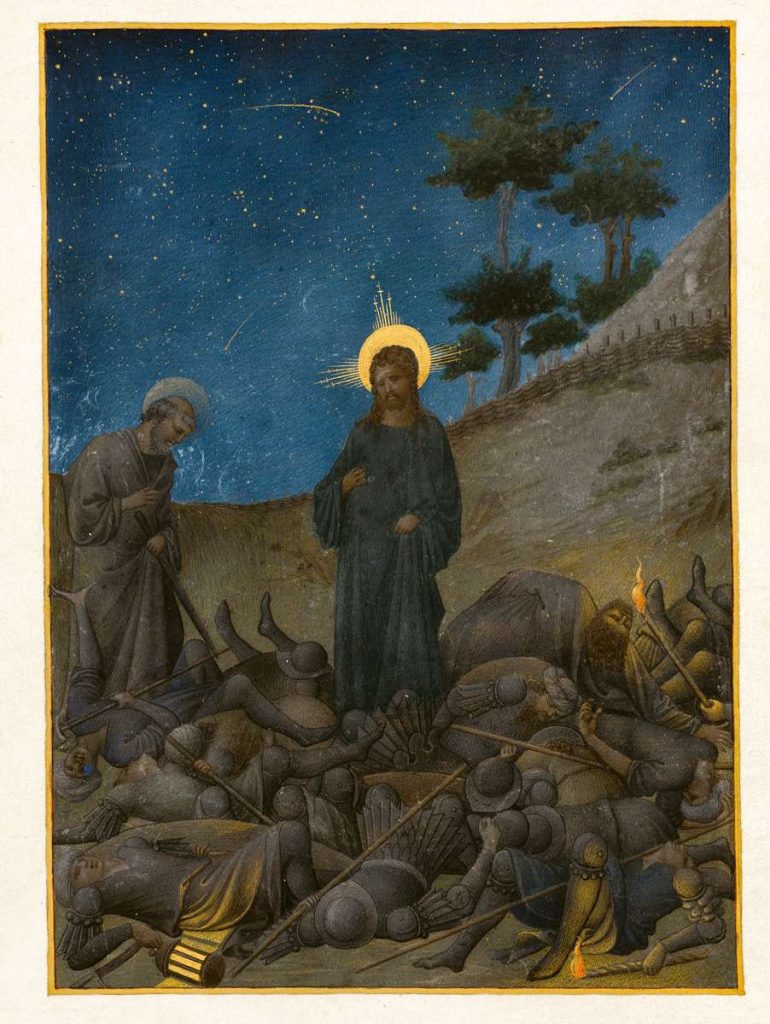
Christ in Gethsemane (1416), Très Riches Heures du Duc de Berry, folio 142v.,
Paul de Limbourg (c. 1386/1387–1416).
A medieval prayer book lies open, and gilding gleams as shadowy figures emerge from the painted page. Domine labia mea aperies… “Lord, open my lips…” The first words of the Invitatory break the stillness. Et os meum annunciabit laudem tuam. “And my mouth will proclaim your praise.”
This hauntingly beautiful Christ in Gethsemane introduces the nighttime office of Matins in the Très Riches Heures of the Duke of Berry, an illuminated Book of Hours intended for use by the laity. Rendered by Paul de Limbourg in 1416, this particular episode from Christ’s arrest is seldom depicted in the history of art, often overlooked in favor of the Agony or the Kiss of Judas. John’s Gospel alone relays the event: Jesus, knowing everything that was going to happen to him, went out and said to [the soldiers], “Whom are you looking for?” They answered him, “Jesus the Nazorean.” He said to them, “I AM.” Judas his betrayer was also with them. When he said to them, “I AM,” they turned away and fell to the ground (18:4-6).
Christ’s pronouncement of the divine name confounds his captors; he is the very same who instructed Moses: Tell the Israelites: “I AM has sent me to you” (Ex 3:14). The encircling band falls thunderstruck—not forward in adoration but backward, unyielding to the last. With the breath of his mouth Christ lays waste to the wicked (cf. Is 11:4); their bodies twist in a rhythmic tangle at his feet, like the serpentine devil that strikes at the heel. This figural arrangement alludes to sin and death. The same foreshortened, fallen torsos and unnaturally angled limbs are used elsewhere by Limbourg to depict plague victims and men struck down by divine fire. Spiritually lifeless, entirely earthbound, only one of the soldiers opens his eyes. Yet even he stares blankly, groping in the darkness with an extended arm.
Christ stands above the tumult in majestic solitude. The gentle s-curve of his posture is echoed by trees rising from the slopes of Olivet, suggesting harmony with the created order. These strong verticals draw the eye aloft, beautifully balancing the weight of the figures below.
The power of darkness
Preceded only by Gaddi’s Annunciation to the Shepherds (1328), Christ in Gethsemane is one of the earliest nocturnal scenes in Western art. In the midst of a manuscript bursting with riotous reds, intense lapis blues, and demure pinks, the viewer’s eye must adjust to perceive the exquisite subtleties of this illumination. With extraordinary naturalism, it convincingly captures the muting effect of darkness on the nature of color.
Stripped of decorative elements and boisterous hues, the scene’s visual silence sets a meditative tone. Besides Christ, all figures are rendered mostly in gray. Even Peter blends with the shadowy soldiers, though he is crowned with a dim silver halo. Standing to Christ’s right in an imitative yet deferent pose, he represents the Church—mediator of grace and power—conformed to the divine Bridegroom.
Natural light sources fade before the otherworldly brilliance of Christ’s halo, and the Savior’s already somber form appears darker still by contrast. It was folly to light torches by which to seek the Sun; scattered on the ground, their flames scarcely penetrate the heavy pall of night. One pointedly reveals the face of Judas, whose twisted neck foreshadows his imminent suicide. The sound of Christ’s voice—an arrow to his conscience—was more terrible to the traitor than to the lawless mob. Darkened within, he falls headlong away from the Light.
Fixed and falling stars
Overhead, the sky scintillates with pinprick stars. It was not until 1609, with the invention of the telescope, that a detailed rendering of the Milky Way in Elsheimer’s Flight into Egypt surpassed the precocious realism of Limbourg’s night sky. Though stylistically ahead of its time, it reflects an ancient cosmology—one favored by Ptolemy and Aristotle and later adapted to the medieval worldview. The viewer gazes into the Stellatum, a firmament of fixed stars beyond the wandering planets. The predictable procession of these celestial bodies governs the cycle of time.
The Très Riches Heures begins with twelve calendar pages depicting the labors of the months. Arable farming and animal husbandry—harvests and hunts—the rhythms of medieval life emerge with great vibrancy. Above each illumination, a starry arch bears the appropriate constellations—steady and sure beacons in the immutable heavens—alongside the monthly liturgical feasts and feriae.
This context allows the modern viewer to share the visceral disquiet of the medieval audience at the disturbance of the stars. Three gilded trails of light streak above Gethsemane. These falling stars signify fundamental disorder and disorientation; they portend disaster (from the Latin pejorative dis- and astrum, star). The universe is shaken on the eve of cosmic chaos: the death of the Creator.
Prefiguration
Silhouetted against the darkened landscape, the Word stands silent as the night. Once prostrate and pleading in agony, he rises to meet his hour with noble resolve: No one takes [my life] from me, but I lay it down on my own (Jn 10:18). Though Christ’s foes are disabled, he forgoes the opportunity to flee.
Christ’s downcast gaze veils the weighty anguish he bravely bears within. He moves through his Passion toward a death that bears the signs of emptiness and division. Pioneer (“trailblazer” in Greek) and perfecter of faith (cf. Heb 12:2), Christ enters the bottomless pit and defines its depths; he enters the endless darkness and sets its limits with his radiant light. Christ enters the death that is emptiness and fills it with himself, thereby forging a glorious path for his saints to follow.
In Gethsemane, though black grief and terror surge on every side, even the hour of the Prince of Darkness contains a glimmer of this Paschal joy. Within three days, a band of soldiers will once again fall to the ground like dead men (Mt 28:4) at the force of Christ’s majesty. This time, however, their bodies will encircle the entrance of an empty tomb.
Amy Giuliano
Holds degrees in art history from Yale and theology from the Angelicum, Rome.

Additional art commentaries