



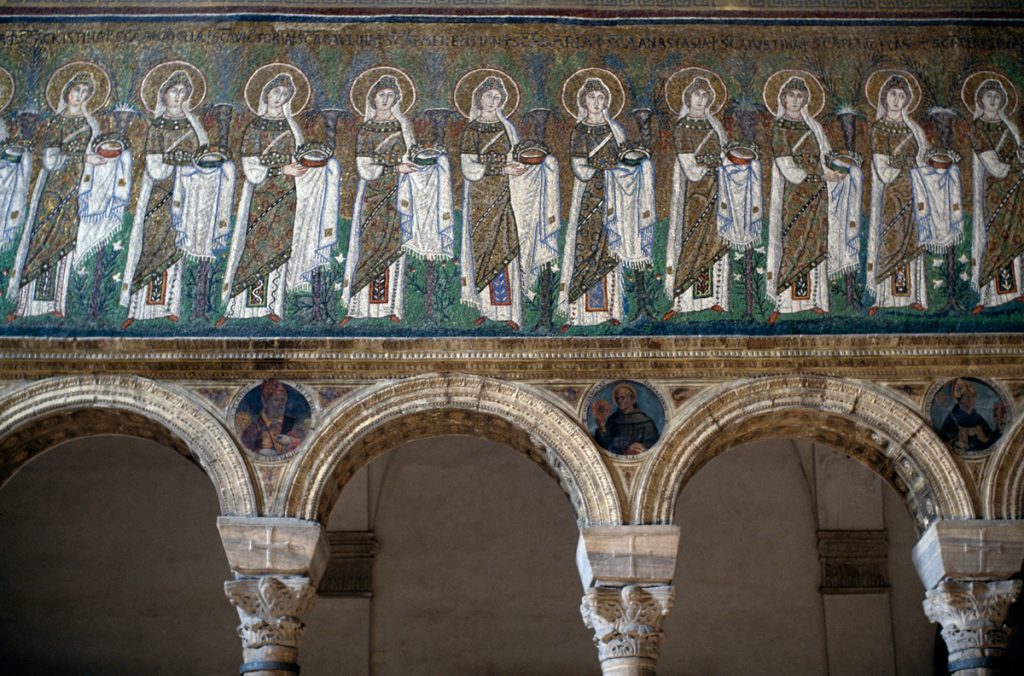
Procession of Female Saints (c. 504), Unknown.
The mosaics of Ravenna and the communion of saints
This image of a procession of female martyrs is found at the Basilica of Saint Apollinaris in Ravenna, Italy, and it is one of the most stunning mosaics that comes to us from the early Church. The Basilica was finished at the beginning of the 6th century by Ostrogothic king Theodoric the Great and has undergone many renovations and name changes; this mosaic is one of the original decorations of the church.
The artistic style may strike us as Byzantine, that is, of eastern influence, but Ravenna at the time of the construction of this church was home to the Roman emperor. A strict East-West divide in artistic style does not come until much later in the history of Western art. The gold and glittering tiles are so striking that legend has it Saint Gregory the Great (r. 590–604) asked for the images to be darkened to ensure worshippers were not distracted. For us, in the month of November, these gilded figures serve as a wonderful starting point for contemplating the citizens of heaven—the saints—and our relationship to them.
Placement in the church
In order to understand the effect of this mosaic and its theological meaning, it is important to grasp its location in the church. The procession stretches the entire north wall of the church. If you stand at the door facing the altar in the basilica, this procession of female saints covers the left side and a procession of male saints covers the right side. The female saints process from an image of the port of Ravenna to an image of the Virgin Mary with Child and angels. They are led by the three Magi. The male saints process from an image of the palace in Ravenna to an image of Christ enthroned with angels. This arrangement will later become standard with images in eastern churches (Mary and Child on the left of the altar, Christ seated on the right, with saints on both sides).
The location of these images reflects the actions of the worshippers during the liturgy. At this period, men and women occupied different sides of the church during worship. Standing was also the usual posture during the liturgy.
The liturgy as heavenly worship
This beautiful mosaic teaches us in many ways about the communion of saints, liturgy, and everyday holiness.
First and foremost, the experience of worshipping in this space must have made the presence of the saints palpable. The golden aura and heavenly setting of the mosaics make visible the invisible setting of the liturgy. In the Mass, we truly participate in the worship of heaven and come into the presence of saints and angels. The mosaics express the truth of what we might not always sense: we are standing in heaven and in the company of heaven, or at least within its gates (cf. Ps 122:2).
In particular, the mosaics make visible the invisible presence of the saints named in the Eucharistic prayer, who join in making the offering of the Mass. Many of the saints of the Roman canon are found in this mosaic. The Roman canon, which we refer to as Eucharistic Prayer I, was in use by the 6th century, although it was not fully set in the form that we know today until the 7th. On the women’s side, for example, you should see familiar names: Perpetua, Felicity, Agatha, Lucy, Agnes, Cecilia, and Anastasia. The fact that the saints are lined up, one after another, with little distinction between them is reminiscent of a list like the one we find in the Roman canon.
What is remarkable about these women is the kind of death they share—they are martyrs. The sacrifice that these women make, they who cast their crowns before the throne (Rv 4:10), is that of their whole lives. Of the nature of Christian worship, Saint Augustine writes: “This is the sacrifice that the Church continually celebrates in the sacrament of the altar (which is well known to the faithful), where it is made plain to her that, in the offering she makes, she herself is offered.” In union with the one body of Christ, we become the offering that Christ is, as the martyrs well know.
The mosaic, therefore, is not just meant to overawe the worshipper with the heavenly presence of the saints or to heighten the majesty of the liturgy. It also calls each person to the holiness of these saints. In the images, the saints are literally traveling from the city of Ravenna to heaven—as mentioned above, the left procession begins at the port, and the right procession begins at the castle. Both processions arrive at the heavenly throne, the saints having won the race and obtained their crowns (cf. 1 Cor 9:24). These saints on the walls of the church stand beside and among the regular people—not merely at the front of the church. The summons is clear: Travel alongside these men and women, on the same road, so that you too may arrive not only at the Eucharistic altar but at the heavenly one, giving your life to God. The saints are worshipping with the people of Ravenna, standing in a Communion line alongside them so that all may come to the same resting place.
Elizabeth Klein
Associate professor of theology at the Augustine Institute in St. Louis, Missouri.
Procession of Female Saints (c. 504), Unknown, Basilica of Sant’Apollinare Nuovo, Ravenna, Italy. © Bridgeman Images.


Additional art commentaries