



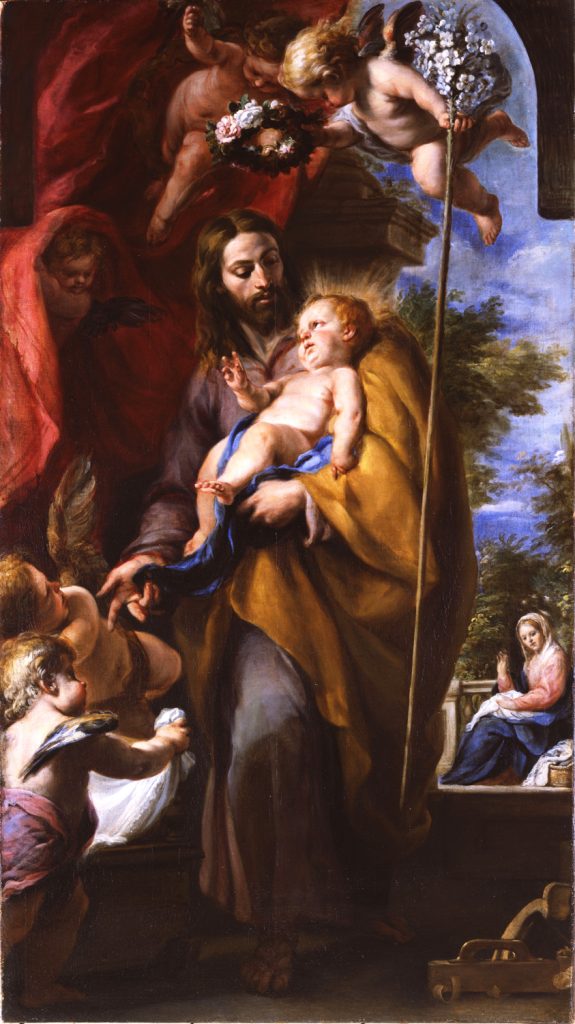
Saint Joseph and the Christ Child (1666), Claudio Coello (c. 1642–1693).
To those accustomed to images of an aged Saint Joseph, bent and wizened by the burden of his responsibilities, this painting by Claudio Coello may come as a surprise. Here, the foster-father of Jesus appears youthful, commanding, and manly, almost upstaging the Blessed Virgin as he strides towards us, the infant Christ in his arms.
This painting exemplifies the seismic shift that took place in artistic depictions of Saint Joseph during the 17th century. Earlier representations favored an elderly sedentary figure, an awkward attempt to reinforce the teaching of Mary’s perpetual virginity by visually dismissing Joseph as a debilitated geriatric, essentially harmless to women. Ever gallant, Saint Joseph lent himself to this humiliating guise, but centuries of spiritual reflection would inspire artists to decorate him with a coat of many colors—protector of husbands, workers, fathers, the papacy, the dying, and eventually, in 1870, the Universal Church.
A new look for a new era
Saint Joseph’s most radical artistic reimagining, however, took place after the Protestant Reformation. His white hair turned to raven locks, his bent back straightened into a proud bearing, and his worried mien gave way to calm confidence. The architects of the new, improved Joseph were some of the greatest figures of Spanish Baroque spirituality, Jerónimo Gracián and Saint John of the Cross, incidentally both spiritual directors to Saint Teresa of Ávila. Teresa would place seven of her convents under Joseph’s protection, inviting the world to “go to Joseph.” Together with the treatises and homilies of Gracián and Saint John of the Cross, Teresa‘s writings on Joseph, an intercessor powerful enough to deliver her from “danger…both of body and of soul,” inspired artists to take a fresh look at an old saint.
The shape of Coello’s six-foot painting clearly denotes its function as an altarpiece. The Spanish painter, artistic heir to Velázquez and Murillo, depicts the saint towering above the altar. Despite his formidable stature, Joseph embodies gentleness, effortlessly cradling the charmingly chubby Christ Child. Joseph’s gaze is both loving and authoritative as he points towards the crib in the lower left of the canvas. The tools on the right suggest that Joseph crafted the bed himself. A closer look at the cradle reveals his elegant carpentry.
Joseph wears a long cassock-like robe, tinged with a hint of purple. This royal color alludes to Joseph’s kingly lineage as a descendant of David. His mantle radiates with a golden glow, but the richness of these colors is muted by the liberal addition of brown. Instead of regal arrayment, Joseph conceals his splendor under a cloak of humility. From the Latin word humus, meaning “earth” or “soil,” humility describes this image perfectly. Mary sews quietly in the background (though she might appear to be sweetly “waving” for the camera) while Joseph puts the baby to bed. This is an image of humble domesticity, the simple tasks proper to men and women of the age. They don’t seek glory but quietly serve the one who has yet to be glorified.
In our age, which coined the unfortunate term “toxic masculinity,” Saint Joseph, with his quiet virility, provides us with a robust image of real manliness, the vir in virtue. Joseph’s staff rises beside him, the bourgeoning bouquet at its summit a symbol of his purity and self-mastery. A loving father, a solicitous spouse, and a hard worker, Joseph kept company with shepherds, Magi, and Egyptians, and despite his scriptural silence, he was a man of action as well as contemplation. In art, Joseph was transformed from awkward appendage to universal role model, visual support for Saint Teresa’s claim that there was no one who was “truly devoted to him…who has not advanced more in virtue.”
A familiar face
Joseph’s face in this altarpiece would have looked familiar to the faithful, for it bears a striking resemblance to images of the adult Jesus. Here, Coello, deeply imbued with Spanish Counter-Reformation spirituality, visually interpreted Gracián’s remark that Joseph was like Christ in “countenance, speech, complexion, habits…and way of life.” Angels frolic below and above the saint; they serve the Christ Child, yet they are also a reminder that Joseph communicated with angels on no fewer than four occasions, an extraordinary link to the divine.
The scarlet drapery rises like a theater curtain, drawing our eyes to this charismatic figure who is meant to be emulated, admired, and invoked, yet in his discreet manner Joseph directs our attention to his luminous son. He gestures towards the crib, which resembles a coffin, while the bright white linens call to mind the shroud.
Coello’s marvelous altarpiece pays homage to Saint Joseph and provides us today with an inspiring example of the Holy Family in a charming scene. But before its exile to the sterile walls of a museum, its true power would have been felt during the Mass, when the priest, lifting the Host above the altar, would have complemented Joseph’s motion of lowering the Child to the crib, drawing together heaven and earth in the real presence of Christ’s Body upon the altar.
Elizabeth Lev
Writer and professor of art history in Rome.

Additional art commentaries