

Online novena
Enter into Hope with Saint Thérèse of Lisieux
Day 6
Thérèse as Novice-mistress
Listen to this novena
Word of God
A reading from the second Letter of Saint Paul to the Corinthians (13:7-13)
But we pray to God that you may not do evil, not that we may appear to have passed the test but that you may do what is right, even though we may seem to have failed. For we cannot do anything against the truth, but only for the truth. For we rejoice when we are weak but you are strong. What we pray for is your improvement.
I am writing this while I am away, so that when I come I may not have to be severe in virtue of the authority that the Lord has given me to build up and not to tear down.
Finally, brothers, rejoice. Mend your ways, encourage one another, agree with one another, live in peace, and the God of love and peace will be with you.
Greet one another with a holy kiss. All the holy ones greet you.
The grace of the Lord Jesus Christ and the love of God and the fellowship of the holy Spirit be with all of you.
Listening to Saint Thérèse
From a distance it appears all roses do good to souls, making them love God more and molding them according to one’s personal views and ideas. At close range it is totally the contrary, the roses disappear; one feels that to do good is as impossible without God’s help as to make the sun shine at night. One feels it is absolutely necessary to forget one’s likings, one’s personal conceptions, and to guide souls along the road which Jesus has traced out for them without trying to make them walk one’s own way…
I told you, dear Mother, that I had learned very much when I was teaching others. I saw first of all that all souls have very much the same struggles to fight, but they differ so much from each other in other aspects that I have no trouble in understanding what Father Pichon was saying: “There are really more differences among souls than there are among faces.” It is impossible to act with all in the same manner. With certain souls, I feel I must make myself little, not fearing to humble myself by admitting my own struggles and defects; seeing I have the same weaknesses as they, my little Sisters in their turn admit their faults and rejoice because I understand them through experience. With others, on the contrary, I have seen that to do them any good I must be very firm and never go back on a decision once it is made. To abase oneself would not then be humility but weakness. God has given me the grace not to fear the battle; I must do my duty at all costs.
Manuscript C, 22-23
Excerpts from Saint Thérèse’s autobiography: Story of a Soul, translated by John Clarke, O.C.D.
Published by ICS Publications. Copyright © The Discalced Carmelite Friars, Washington Province.
Used with permission. www.icspublications.org
Reflection
Thérèse is well placed to know that no one is left behind in the great struggle for holiness. She felt incapable of performing the glorious deeds of the great saints whose stories she had heard, but thanks to her astute reading of the Gospel, inseparable from her deep understanding of God’s love, she succeeded in bringing holiness down to earth. Her message, in particular through the doctrine of the little way, makes the universal vocation to holiness audible and comprehensible to all. Being a Christian makes no sense outside this lofty perspective, insofar as the whole of revelation teaches us that this is our vocation, the only possible place for a true restoration of man to his dignity as a creature capable of divine happiness.
But Thérèse is also well aware that the sanctification of man, the work of God in collaboration with the freedom of each individual being, takes place gradually here on earth. It is a path of perfection, during which grace enables us to shed our sins and enter into the light. But while holiness is for everyone, and each person’s journey is a progression towards the same heaven, each person’s holiness takes a unique form. Father Pichon’s words, “There are really more differences among souls than there are among faces,” left a lasting impression on Thérèse as novice-mistress. To become a saint is not to fit into a predefined mold of Christian perfection, but to learn to love as only one can, with one’s own history, uniqueness, and capacities; to live the great commandment of love according to who you really are. Everyone is therefore called to a transcendent destiny, and despair makes no sense, because no one is called to accomplish things for which he or she is not made.
By Jean de Saint-Cheron
Prayers
Psalm
Psalm 19:8-14
The law of the Lord is perfect,
refreshing the soul.
The decree of the Lord is trustworthy,
giving wisdom to the simple.
The precepts of the Lord are right,
rejoicing the heart.
The command of the Lord is clear,
enlightening the eye.
The fear of the Lord is pure,
enduring forever.
The statutes of the Lord are true,
all of them just;
More desirable than gold,
than a hoard of purest gold,
Sweeter also than honey
or drippings from the comb.
By them your servant is warned;
obeying them brings much reward.
Who can detect trespasses?
Cleanse me from my inadvertent sins.
Also from arrogant ones restrain your servant;
let them never control me.
Then shall I be blameless,
innocent of grave sin.

Hail Mary
Our Father
Intercessions
With Thérèse, let us turn to the Father who opens the way to holiness for us:
R/ Lord, lead us on your path.
Comfort parents, teachers, and educators in their role as guides and models for the young people they accompany in their growth: R/
Grant that all who are responsible for souls through their profession or vocation may guide those entrusted to them toward holiness: R/
Allow us, through your grace, to discover each day a little more how to progress in holiness: R/
Father of tenderness and goodness, you chose Thérèse to be mistress of novices at her Carmelite convent during her earthly life; may she continue to guide us from heaven on the little way of trust and love that she opened up for us. Through Jesus Christ, your Son.

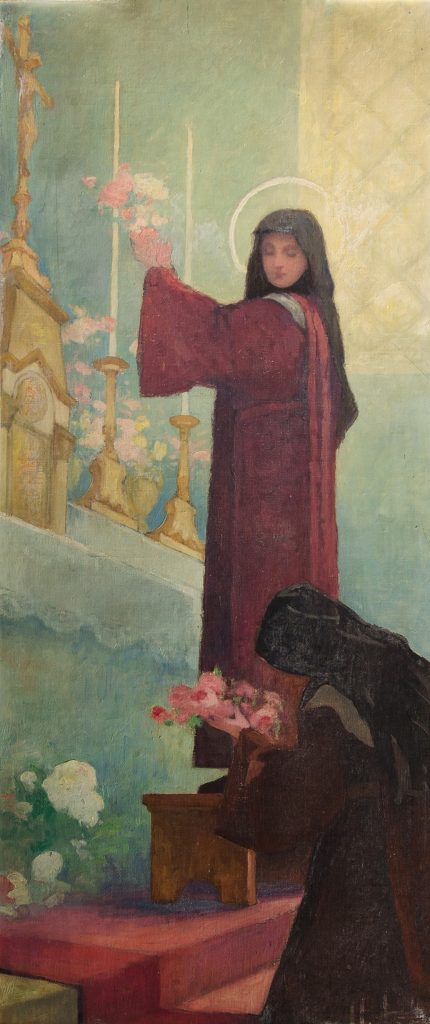
Painting: Amédée Buffet (1869–1934), Saint Thérèse and a Nun, Saint Joseph des Carmes Church, Paris. © City of Paris, COARC / Jean-Marc Moser.
Photo of Saint Thérèse: © Office central de Lisieux.
Flower paintings: © Alamy.
